

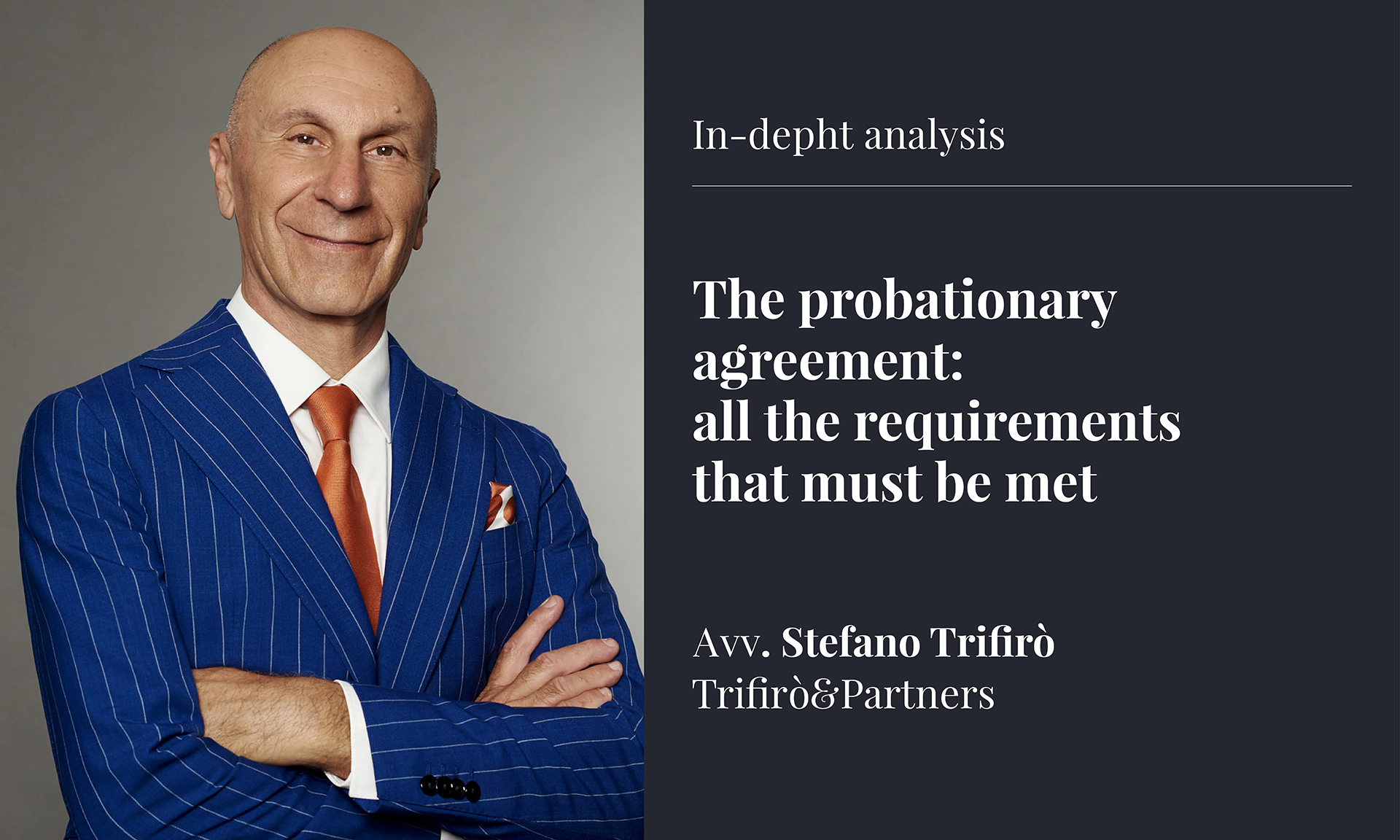
The probationary agreement: all the requirements that must be met
In-depth analysis by Attorney Stefano Trifirò.
The probationary agreement is a mechanism that allows no missteps: behind just a few contractual lines lies an extremely rigid framework, where even a single mistake is enough to turn a withdrawal into an unjustified dismissal.
Attorney Stefano Trifirò, co-founder of the law firm Trifirò & Partners, warns companies: “What many still perceive as a mere procedural step at the moment of hire is actually one of the most technical and sensitive institutions in employment law.” The issue has regained prominence not only because of the new provisions introduced by the Transparency Decree but, above all, due to a recent jurisprudential shift that has redefined the consequences of invalidity.
“The legislation,” Trifirò explains, “has clarified the proportionality of the probationary period in fixed-term contracts and its suspension in the event of protected absences, reaffirming the principle of effectiveness: the trial period must be real, and days of absence cannot be counted.” The core of the institution remains the employer’s freedom to withdraw during the probationary period, which the Court of Cassation has always considered discretionary and not subject to justification. But this freedom is not absolute: the employer must ensure that the employee is truly able to carry out the probation.
“A precise indication of duties is essential: without a clear perimeter, there is no real trial period,” the attorney stresses. The most sensitive area, however, concerns the nullity of the probationary agreement and its consequences.
“A ruling by the Constitutional Court marked a turning point: if the agreement is inherently null—lacking written form, missing defined duties, or not executed concurrently with hiring—the withdrawal is no longer a termination ‘during probation’. It becomes an unjustified dismissal, and the employee is entitled not only to compensation but also to reinstatement under the reduced protection scheme,” the attorney notes. The Court of Cassation has already applied this principle in a recent case: “An employee dismissed for failing to pass the probationary period was reinstated because the agreement was null. The employer was also ordered to pay compensation of up to twelve months’ salary,” recalls Trifirò.
In this context, the probationary agreement can no longer be treated as a formality. “It is not a free-exit zone for the employer. It is a technical institution that requires rigour, clarity and careful contractual drafting. Its invalidity leaves no grey areas: withdrawal turns into unlawful dismissal, with all the resulting consequences,” Trifirò concludes.