Condividiamo l'approfondimento dell'Avv. Antonio Cazzella,pubblicato su DirittoBancario, che affronta il tema del coordinamento tra committente e appaltatore nel contesto di un contratto di appalto di servizi, soffermandosi sulle possibili criticità legate all’esigenza del committente di controllare e di verificare la corretta esecuzione del servizio con l’autonomia gestionale ed organizzativa che deve ravvisarsi in capo all’appaltatore.
The probationary agreement represents one of the most delicate junctures of the employment relationship, a mechanism often perceived as a mere initial formality but which, in reality, holds implications of great legal significance: a formal or substantive error can turn an ordinary withdrawal into an unjustified dismissal, with serious consequences for the employer. We share the analysis by Avv. Salvatore Trifirò, published in Corriere Economia.
Lo Studio ha recentemente ottenuto provvedimenti giudiziari in materia di: proroga dei termini previsti dal CCNL per l’adozione del provvedimento disciplinare, smart working, orario di lavoro di un dipendente con qualifica di quadro, licenziamento per inadempimenti nello svolgimento del lavoro assegnato, rilevanza del “pendolarismo” quale presupposto per impugnare un trasferimento con procedimento d’urgenza. Condividiamo l'approfondimento a cura dell'Avv. Antonio Cazzella.
We share below an in-depth analysis by Avv. Stefano Trifirò, offering a clear and up-to-date reading of the evolution of corporate welfare in Italian SMEs. The analysis shows how remuneration policies and welfare tools are not separate elements, but integral parts of a modern employment law strategy, capable of combining efficiency, employee participation and organisational sustainability. A regulatory framework in constant evolution, combined with sound internal design, allows companies to create value and strengthen relationships of trust, turning remuneration into a genuine driver of cohesion and shared growth.
The Court of Cassation has recognised that deceiving a patient with illusory therapies undermines their self-determination and justifies compensation. This is a confirmation of the role of Article 32: protecting health also means safeguarding the clarity of one's choices, especially when all that remains is to choose one's own path with truth. Analysis by Avv. Bonaventura Minutolo
The methods for submitting resignation represent a matter of great practical relevance for employees and employers alike, especially in light of the continuous interpretative and case-law developments of recent years. The analysis by Avv. Anna Minutolo (Trifirò & Partners Avvocati) offers an updated overview of a particularly delicate aspect: the applicability of the mandatory online procedure also to resignations tendered during the probationary period.
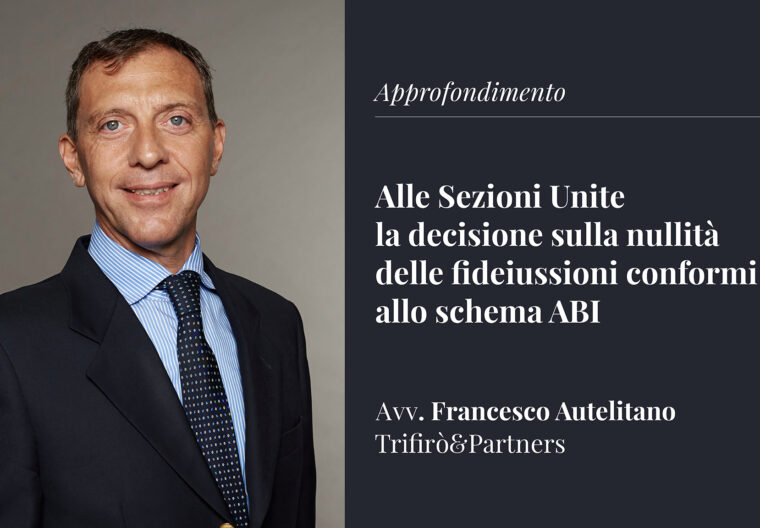
The order of 11 November 2025, whereby the First President of the Court of Cassation referred to the Joint Sections the question of guarantees compliant with the ABI scheme, marks a decisive step in a legal area still characterised by conflicting interpretations. We share the analysis by Avv. Francesco Autelitano.
With judgment No. 156 of 30 October 2025, the Constitutional Court once again intervened on Article 19, first paragraph, of the Workers' Statute (Law No. 300/1970), declaring it constitutionally illegitimate insofar as it does not allow workers to establish company trade union representative bodies (RSA) on their own initiative, even within the context of the trade union associations that are comparatively more representative at national level.
Condividiamo l'approfondimento dell'Avv. Antonio Cazzella,pubblicato su DirittoBancario, che analizza la rilevanza del rendimento connesso alla prestazione lavorativa fornita dal dipendente e la connessa sua valutazione ai fini dell’irrogazione di misure disciplinari.
We share the article by Avv. Antonio Cazzella which, based on the most recent case law review, highlights a constant evolution in the interpretation of the relationship between employer and employee, moving towards an increasingly refined balance between the protection of individual rights and the legitimate exercise of employer powers.